Showing posts with label KA-RO-551. Show all posts

Thursday, December 20, 2012

Karossi reactivation


The first thing we wanted to do after we got to Ankara was finding our car. We headed to the official Volkswagen center, but unfortunately, it wasn't there. It took some time and a few phone calls to find out, that the truck got stuck shortly before the city, because of some technical problems, but the car would be there tomorrow. And so it was. Unfortunately the truck came to late and was stopped from entering the city (they are not allowed to drive through during the day), so we had to make a round trip to collect the car and get it to the right place, using Gerrit's car and our towing experience again. And the place was right indeed. I do not believe we could have put Karossi in any better hands.

Shortly after arrival we have met Eren, another member of the VW club, who not only speaks perfect English, but also knows T3 Syncros by heart. He has repaired and rebuilt his own car so often, that I guess he could do it in sleep now. He took us to Mustafa, the best VW specialist in town. He is actually specializing in Beetles, but can repair Transporters just as well, which we were happy to witness. The garage was a simple place, no high tech toys or expensive gadget, but a few guys who liked old cars and had fun bringing them back to life. However, the diagnosis stayed the same, we had to open the engine and exchange quite a few parts. We were stuck in Ankara for at least a week.


I will not lie to you, we did not have the time of our lives in Ankara. All days were pretty much the same. We were going to the garage after breakfast and coming back in the evening to get some dinner. We had fun and enjoyed the time we spent with Mustafa and his friends, but we would rather have Karossi running again to get on the road and see the rest of the country. I felt especially useless, as there was not much I could actually do. Guys were running all over the place, helping with parts and tools, while I was spending long hours in Mustafa's room, writing our blog, organizing pictures and reading books.

Ankara is quite a nice place, but it doesn't really have that much to offer for tourists. It does have some nice restaurants and cinemas playing movies in original tone, but apart from that it is just another big city. But we had a friend who helped us communicate and organize everything, a specialist, who knew how to fix our car and all the spare parts we needed, so we had no reason to complain. And we even had some time for sightseeing, since the garage was closed on Sunday.


Monday was supposed to be the big day. The engine was nearly complete and all we had to do was to get it back in the car and pray it would work. It turned out to be quite a challenge, as the engine was not really willing to move anywhere, especially not back to where it belonged. But the guys didn't leave it much choice. I guess we all stopped breathing for a moment when Mustafa turned the keys to start the car. But Karossi responded instantly, sending huge clouds of black and white smoke and plenty of dust into the air. And he sounded good again. Everything seemed fine, apart from the fact, that the oil lamp was blinking like crazy. Something was still wrong, but since it was late, we decided to leave it till tomorrow.

We were not in the best moods when we came back next day. But when we arrived, we saw Karossi running again, no lamp blinking. Mustafa told us he had a sleepless night and stayed awake to analyze everything until he got to the conclusion, that everything had to be all right and the only explanation would be, that the oil sensor got broken on the way. It turned out he was right again. We did a test drive, then another one and when everything seemed OK, we left for Istanbul not to loose any additional day. You can imagine we were a bit oversensitive on the way, checking oil and water every hundred kilometers and listening carefully to every single noise our car made. But everything looked fine. We were loosing a bit oil, but not enough to start worrying seriously and Eren already organized a garage in Istanbul, which agreed to check everything again, just to make sure it's still fine. We were back on the road!


We have both been in Istanbul before and although we liked it a lot we were not planning to stay for too long this time. Especially that Christmas was getting closer and closer and we still had a long drive home. We just wanted to have a nice walk through the city, visit the places we liked best the last time and save the rest of time and money for the big bazaar. We had some second thoughts about it, but when we noticed, that the entrance fees for most sites are around 15 Euro we gave it up for good and decided, we would rather invest this money in a nice backgammon set, since Hafez has definitely managed to get us addicted to this game.


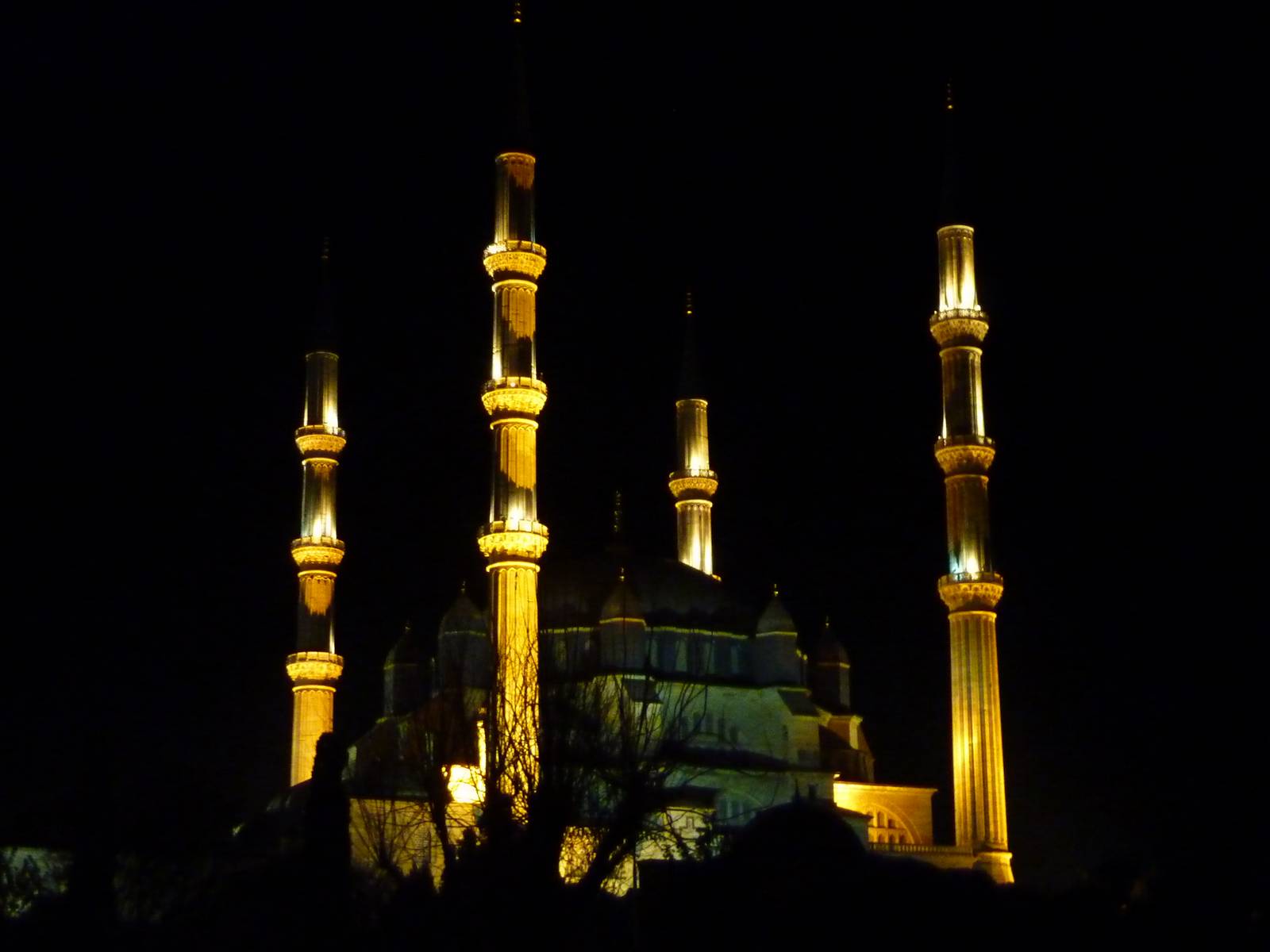
For the last night in Turkey we have chosen a small city called Edirne, which proved to be a perfect choice. Though it was just a short stop on our journey it allowed us to see the beauty of Islamic culture once again. Its magnificent mosques looked especially pretty during the night and the bustling bazaar was a perfect place for the last minute shopping. When all the last presents and souvenirs were bought, we were ready to go back home.

The border formalities went pretty quickly and before we noticed we were back in EU. I would love to tell you that European part of our journey was just as nice and adventurous as the rest of it and as interesting, as we originally planned it to be, but I'm afraid it would not be quite true. We tried to make the best of it, but our time was limited, it was raining all the time and we desperately wanted to get back home before Christmas. So we were basically driving from one capital to another, trying to do some sightseeing in the evening, before we would go to sleep to recover and be able to drive another long hours the next day. It was a pity, but we decided we will visit those countries again as soon as possible, as we are sure they have a lot to offer, especially in sprig or summer time.


But the most important thing is, that Karossi is running well again. He managed to get us home on time, without any troubles on the way, driving across half of Europe. And all that with his summer tires on...

It was not easy to leave him behind, but I'm sure he will enjoy his rest, parked in a nice garage until we come to collect him next spring to get him back home, to Karlsruhe. And for us the journey continues. After a short break spent with our families we are packing our bags again to get all the way down to South East Asia, for the next 10 fascinating weeks. 

Wednesday, December 5, 2012

Misery loves company


Everything seemed perfect. Karossi was back on the road and Europe was getting closer with every hour of the drive. Unfortunately, our joy didn't last long. We haven't even made it till Van, our first goal right after the Turkish border, when Karossi started making some really scary noises and began to loose oil faster than we could refill it. We were stuck again. This time on a quiet and deserted fuel station, in the middle of the mountains, where the temperature were somewhere below freezing. Help was on the way though! Gerrit, who seemed to be getting experienced in saving our lives, was only one day behind us. The situation was not hopeless yet.

Fortunately we were in a Muslim country, where people are famous not only for their hospitality, but also creativity. Before we noticed someone organized tea and warm food and heating was turned on in a nearby praying room. Such rooms can be often seen along the highway, those are usually small spaces with a carpet on the floor and few praying utensils lying around. But for one night, right after the evening prayer it became a bedroom for two. Sleeping there was a bit weird to be honest, but since the only alternative was a unheated, nearly frozen car, we decided to go for it. But how do you behave while sleeping in a praying room? Should you put your head direction Mecca? Or the feet maybe? Should you keep your headscarf on? I still haven't found the answers to all this questions, but we slept well anyway. And the next day we took our beloved towing rope out once again and hang it at the back of Gerrit's car, ready to be dragged for a countless number of kilometers, trying to stay warm in the unheated car, that was for some reason still letting the freezing winter air in. We have gathered some significant experience in those matters, but somehow it still wasn't my favorite way of traveling.

We were all completely run down when we reached Van, so we stayed in the first hotel we managed to find. Tomorrow the whole car fixing procedure would start again. We had no idea where to begin with and we soon found out that communicating in English would not get us far. We definitely needed help. A short internet research led us to a site, which changed our Turkisch adventure for good. When we were posting our question on http://www.volkswagen-t3.com we were not having any high hopes. We described our problem shortly before going to bed, hoping that maybe someone would give us an address or a telephone number we could try for a start. We couldn't believe our eyes when we checked the page the next morning. There was a whole list of new posts and T3 fans from all over Turkey were getting involved to help us solve our problems. Altug, one of the fan club members from Istanbul called us early in the morning and the plan was made. After breakfast we would meet with Enver, a member form Van, who would take us to his mechanic to see what went wrong. And so we did.

I have to make a short pause here, as there is one small, but very important detail, that is certainly worth some attention. The breakfast. In Van breakfast is not just a meal. It's a piece of art! For around 4 Euro per person your table turns into all you can eat and drink buffet, filled with fried eggs, olives, different kinds of cheese and meat, amazing honey dishes and vegetables of all sorts. No matter how hard the day ahead may seem, after such a delicious start all problems look only half as hard and scary.


Unfortunately, our problems were still pretty serious. The mechanic heard the noises only for a few seconds before he knew, what was wrong. We would have to take the engine out and exchange quite a few parts. However, it made no sense to do it in Van, as we would have a lot of trouble finding all the parts and tools we needed. Going to Ankara was the only reasonable solution. Enver started working on this task immediately. We needed to transport Karossi through half of Turkey, the land with highest fuel prices in the world, without ruining our budget. We decided to check it with ADAC, our insurer, to see if we can count on them for any support. Unfortunately, they normally do not cover anything more than 150km and we needed around 1000 km more. Anyway, they told us they need an opinion from the official VW garage to provide us with any help in the first place. We considered it a waste of time, but decided to do it anyway, since the garage was not far and we didn't know what kind of help may still be necessary.

Once again a few seconds were enough to clear the situation and the previous diagnosis was confirmed. We needed parts and a T3 specialist, and Ankara was the place to go. Though they had a very professional garage in Van, with some really good mechanics, they were specializing in the newest models and had too little experience with old cars like ours to risk doing the job. But they wanted to help us anyway. Few phone calls were made, information were exchanged, meanwhile Enver joined us again to help clarify the matters in Turkish language and before we noticed we were presented with a solution, better than anything we could have expected. In a few days a truck filled with new cars would come to Van. The cars would stay there, but the truck, nearly empty, would be driving back to the capital, ready to transport Karossi all the way for a standard flat rate of around 120 Euro. Knowing the fuel prices in Turkey (reaching sometimes above 2 Euro pro liter) we knew we could hardly leave the town for this amount of money, so we accepted it without thinking twice. Moreover, when the garage called our insurance company to clarify the matters ADAC agreed to cover all the costs. We had a plan again.

Only one question remained. What would we do in a meantime. The VW garage told us we only need to leave them the key and the copy of the car documents and they would take care of everything else. We knew we would most certainly get stuck in Ankara for a couple of days anyway, so we didn't want to waste any additional time. We still wanted to see the country and have some fun before we would get stuck in one place again. The decision was made quickly. We packed our stuff in no time and threw it into Gerrit's car. For the coming week we would travel together in his Toyota. It would allow us to do some serious sightseeing and help him reduce the exorbitant fuel prices. We took off immediately. 

Monday, July 23, 2012

Road experience and Lada-Volkswagen fusion


The general impression of road traffic after crossing the border from Estonia to the European part of Russia is striking. Although Eastern European countries still know the concept of former used-to-be highway prototypes including left-turns across opposite lanes, red lights and even zebra crossings at any time on only one and a half lanes in each direction, the Russians take this to the state-of-the-art and push the experience to the max.

On a first glimpse, everything that might be done within the physical limits of time, space and speed will be done deliberately and with hardly any pre-warning such as turning indicators, headlights or horns. This includes passing a slower vehicle without being able to finish the maneuver before opposite traffic arrives, putting temporarily ones life into the hands of the others hoping they will somehow arrange it all to fit. If for any reason traffic stops on a number N of lanes going one direction, after a couple seconds you immediately find yourself in a flow of N+2 lanes, including opposite lanes and unstable dust/stone/grass lanes on your very right. Surprisingly, this all goes without any mayor emotional explosions, the additional lanes are somehow accepted by everyone (including officials) and all merges together as required to the number of N lanes hardly before any major damage occurs. Again, most of this completely without any indications or audible feedback by anyone. Traffic gets stuck very frequently for no obvious reasons, for instance due to zebra crossings which seem to be untouchable as even grand mothers throw themselves onto the road without hesitation and even the largest road train slams the brakes at excessive speed of up to 120 km/h. The newbie also struggles to understand why sometimes traffic slows down due to a slower vehicle as the law of N+2 would not allow this scenario. The explanation for this is a wide-spread warning custody of simple headlight signals to signal other traffic participants the presence of officials, formerly also practiced in France. Changing lanes (for any maneuver including passing slower vehicles) however seems to follow a highly elaborated procedure. In general again, everything within physical limits is allowed, turning signals are considered optional, the behavior and the placement and speed of the vehicle is as much signalization that one could expect. As long as there is no other possibility than changing lane, anything is allowed and everyone else adopts. However, changing lane early because of some distant upcoming obstacle is not generally accepted and responded with horns, which shall not be understood as emotional expression but rather a signal to communicate its presence. Finally speed limits are specified somewhere in the traffic laws but not respected by anyone, inner city driving downtown Moscow or St. Petersburg is frequently at more than 100 km/h, being generally accepted even by officials. There are hardly any stationary speed traps and we have never seen a mobile one flashing or a vehicle with excessive speed being pulled over by the police. The friendly officials only seem to insist on strict obedience of “do not overtake” signals and infrequent drivers license check, which they usually gave up quickly if you talk to them in anything else than Russian.


The road conditions can not be generalized, we have seen anything from excellent driveways like newly built French private highways, most frequently older streets with varying damage from surface bladders down to collapsed foundation with tremendous holes and deep lane grooves and finally also non-existing unpaved dirt/mud/gravel/dust streets instead of the promised highway (giving the creative drivers even a higher degree of liberty when it comes to lane definition. This is valid for urban and rural areas, the road condition may change at any time at no defined city or oblast border.


A couple days ago, we were just to exit the national park in the mountains where we passed the night on lake Zaratkul, diving in the endless void of Western Siberia when Karossi decided to stop operating at once. We rolled out, trying to reach a spot that would give us at least a minimal level of protection against the burning sun and the blasting trucks passing by, getting the head under the hood immediately. Some quick checks showed that spark and gas seemed OK and that there is no easy way to figure out the root cause of the issue and we would need professional assistance. In a country without AAA, TCS, ADAC or whatever the automobile association in your country is called, this is a rather challenging job. Obviously it is possible to find a good mechanic in pretty much any agglomeration, but where to look for one if you sit in the middle of nowhere (N55 19.727 E63 25.519)?


We decide to hitch-hike with Karossi, attached to our towing rope and hope someone would let us attach. We decide to try into our heading direction, saving us a dangerous U-turn by foot, although the next village in the opposite direction would have been a little closer. Quiet surprised that one of the first trucks stops by and pulls us the 30km with something about 60-80km/h into the next village, called Mischkino. Getting towed has never been a good experience, but doing it with an 8m long elastic rope (planned rather for pulling us out of the mud than on a street) behind a colossus of steel on a really unpredictable road pavement stressed me out quiet a bit. Arriving in Mischkino would not relax me for long as we were to find out that there is not any mechanic around before Kurgan, another 100km further east. The incredibly friendly truck driver decided to give it a quick try and grabbed my tools and started working on the engine for a couple minutes, unfortunately coming to the same conclusion as I did: we need professional assistance. He did not hesitate a moment to jump into his truck and wait for me to give him sign that we are ready to be towed for another 100km. In the meanwhile he must have done some logistics with his local contacts as we were hooked off somewhere on the peripheral drive of the city and handed over to the person of all our hope from PitStop, who towed us somewhere in the backyards of his garage. Hardly any tools were used, but a lot of trial-and-error tests were done, including calling in another expert for “old German vehicles”, until the judgment was done: There is an ignition spark, but it is too weak. Cause of the disaster is a defect Bosch ignition coil. And obviously, there is no Bosch service in the surrounding of a couple hundred kilometers. What to do? Theoretically, ignition coils should do pretty much the same all around the world, transfer the 12 volts of the car battery up to a couple thousand volts in order to create the ignition sparks. So why no try with a Russian model out of the Lada of one of the apprentices? Quickly brainstormed whether something would blow up and concluded that this should be done at least once during the existence of human mankind and – it worked! Until today. And quiet honest, Karossi never started that quickly since we got it about a year ago. We called it the Russian experiment and I feel proud to drive along with at least some parts of this proud nation (sometimes really considering to buy a Lada 2107 for my next projects).


Other than that, our Karossi is performing rather well in all the above traffic situations, the suspension compensates all uneven streets well, the roof-top turning lights helped to make the other traffic participants understand the intentions of the “inexperienced” driver during the first days. The interior and the roof mounts disassemble partially from time to time due to the constant vibrations on gravel roads but are tightened at all occasions. The exterior mirrors, the sliding door and the wheel caps need some love from time to time to stiffen them to mitigate noise development but are all still in place. A rather big gravel stone was polite enough to slam our left headlight rather than our windshield because the latter would be rather hard to organize replacement for in Russia.

We will keep you posted about the quiet probable upcoming German-Russian symbiosis experiments.

Saturday, May 12, 2012

Trip planning 6 + 3 months

Trip planning is a tough piece of work. Some may ask why all this hassle, nine months of time should provide sufficient degrees of liberty to start of without any plan at all. Well, this may be true in an ideal world, but unfortunately there is additional complexity of different nature to consider.


Trip prototyping 

The first two possible implementations of our vision to "travel Asia overland" that we considered during our first drafts in the last year were merely based on the factor personal safety and political feasibility. The orange and red bars and borders (from left to right) mark the countries we'd rather avoid like Belarus, which is not the nicest place to be at the moment. The southern Caucasus being shaken lately by violent civil wars in the areas of Georgia, Azerbaijan and Armenia are certainly accessible in some areas, but we do not want to consider to transit them. Not many comments need to be done for the Arabic countries Iraq and Syria where international peace troops still struggle to get the situations under control. Although one of the most famous routes to India let thousands of travellers through the southern or northern routes through Afghanistan and Pakistan, we will have to circumvent these as well. Travel through Bangladesh and Myanmar is not feasible for any foreigner. Last but not least, we had to leave out entire People's Republic of China due to tough restrictions for overland entries which would require detailed trip harmonization with local travel agencies and impose a personal escort (requiring an additional passenger seat and serious financial impact) for the entire journey. (Click here to display in Google Earth)


Two possible routes are shown above, the northern yellow route would only have been possible if we started according to our original plan late March, enabling us to omit the rain season in Mongolia and extreme winter conditions on re-entry to eastern Europe. This option was banned  earlier this year by my beloved employer who decided that I will have to stay until project termination. The southern green route was cancelled after countless enquiries for economic cargo ships available from Vladivostok to Japan (feasible and affordable), south-east Asia (harder to find), India (big challenge and more costly) and back to Europe (unaffordable thanks to serious global sea freight capacity problems).


(Interim) final trip plan 

For all possible trip plans, we performed detailed mileage calculations for the overall trip and rolled out in which week we would be in a given country or area. This allows to check for climatic optimization, double-check against visa restrictions and ultimately also optimize the travel budget with the respective gas prices in each country. Due to problematic access we decided to postpone India to some point later in our lives, decided to reduce to six months travel with Karossi and allow us access south-east Asia by airplane and travel on back-pack for the remaining three months, leaving open the option to travel even Myanmar (which can be entered by airplane for tourism, but not on ground...). (Click here to display in Google Earth)


As we are only 50 days from the beginning of our travel, this might be our final trip plan. At least sufficiently final to endure until we physically hit the road. Once on the way, there will be hardly anything forcing us to keep up with this plan, but there is a general direction we want to go, still providing enough freedom to adopt as required on daily moods, technical or organizational issues, but at the same time stiff enough to keep us moving and omit states of pointless depression caused by diffuse target definitions. 


Miscellaneous

Still fighting with Swiss, Polish and German bureaucracy to finally get married. Found charming successors, Mathias and Lea to take over our flat. They signed today with our landlord, so we terminate our rent on 30th June. Found storage at our friendly neighbours next door. Moving in the flat below after our return, discussing with our landlord that we do look forward to get a balcony and would love to remove the wall between living room and kitchen. Termination of telephone/internet contract troublesome, Alice does not know how to handle situations where customers disappear for nine months. Insurances still critical, no possibility to properly cover liability and theft outside Europe. Looking for petrol additive to increase Mongolia's 76 Octane to something harmless for Karossi. Sand tracks and kinetic tow rope ordered...

Tuesday, May 1, 2012

61 days left


I would love to tell you all the details of the mystic metamorphosis of Karossi from his former being as a purely functional fire fighter transporter into a mobile home with all capabilities of accommodation for two people with essentials like water purification, conveniences as multi-zone foam mattress, basics as table and chairs to more sophisticated electrical transformation into a two-battery supply, everything neatly wrapped into a homogeneous restoration clearly keeping apart old from new. Instead of boring you with all descriptive transformation steps throughout the last 9 months, I will provide you the full programme in only a bunch of pictures. Here we go...


Roof-mount consists of two 60l former German military weapon storage boxes, four 20l petrol cans plus the second spare wheel, the first is placed below the front passenger seats. The remaining space remains reserved for now, most probably for sand plates.  


The passengers cabin is cleaned from obsolete wiring, the only modification on the dashboard is a cork finish to hide the topology recalling good Swiss cheese plus a small compartment for miscellaneous items, most probably Aga's preferred place to put sun cream and other cosmetics. 


Looking backwards from the driver passenger seat we see the water basin, the bed frame (mattress folded to access the central storage area) with two additional tweeters, storage nets along the side windows to pack sleeping bags and other light items such as jackets and - my biggest pride - the central control unit to operate the electrical system of the entire vehicle.


The direct way back from the cabin to the rear is blocked by the cooling box and map compartment, both can be crossed easily for the rare rainy days. Hopefully we will be able to get access to the living area more frequently from the side sliding door. Easily accessible are the two folding chairs and the rollable table, properly wrapped in their green bags inside the kitchen box.


Back-to-back with driver and passenger seat we have placed the cooling box, a highly efficient compressor model to save a maximum on battery power from Engel, monopolist to build products with the Sawafuji swing compressor (Japanese-made), ruggedized and absolutely immune to inclination which is absolutely crucial given the road condition in most countries we plan to travel. Additional information for Engel MR-040F. What remains in the cold for days will eventually end up in the pan. Liquid gas burners would be useless in most countries unless we wanted to carry large amount of gas cartridges or countless adapters for the incompatible national systems. Although disliked by many due its pyrotechnical surprises that may happen at any time, we will do most of our cooking on a Coleman Burner Dual Fuel stove, fed by unleaded petrol that also feeds our Karossi. Self-importing this burner from REI in Farmington Hills (Detroit, US) saved me about half of the price, but I admit that airport security did not share my enthusiasm.


The water tank is placed below the bed, the basic capacity is 65l which allows us to travel the deserts of Mongolia and Iran safely, an additional two water bags with 20l each adds safety margin and can be stored on the roof. There is no need for drinking water access at any time thanks to the (Swiss!) Katadyn Superdyn filter (similar to Katadyn Vario but optimized for automatic operation) which filters water mechanically to assure biological cleanliness and chemically to neutralize any non-organic toxins. The water tap delivers up to 12l/min either filtered or unfiltered, the pressure is generated by a Fiamma Aqua 8 water pump, a reliable and economic product from pretty Italy! 


Water tank and engine control unit (probably the only part in the bus which can not be repaired using a screwdriver, a hammer and pliers) are hidden by our traveller's sized bed, 110cm in width and 190cm in length, just 4cm too short to put myself asleep.


Despite the fact that we take off on brand new tires, the probability of flat tires is as good as assured. A wheel change on regular roads is simple, but on sand or in mud this becomes rather difficult. Also when the car is buried in unstable terrain, the best solution is a so-called High Jack or Farm Jack. At 16kg of weight, we found the perfect spot for it right beneath the kitchen box, rather than shifting the center of gravity even higher up by fixing it on the roof carrier.


Minor detail on the left will allow us to attach rather essential gear. A mosquito net is urgently required for anyone travelling the Russian wetlands during summer time. We will provide you with a detailed analysis of the scoring effect of these beasts only two months from now. Roof lights are made of Osram LEDs, just the best in energy efficiency available on the market today. Some may recognize the goose neck on the right. Yes, it is Swedish and costs 9,99Euro at IKEA. Minor modifications allow to run them on a 12V car battery.


Plenty storage space is available in the side lockers along the vehicle.The plan however is to start with little and return with plenty, but we will see... (I'll keep you posted on Schnuffka's desperate trials to fit all her dresses on her side of the vehicle).